
Nick's Travel Tips
Driving in France
|
This is a collection of information about driving in France, based on what I have learned in driving some 5000 km in that country. It does not try to cover every French road law.
Starting with the most basic fact: France drives on the right-hand side of the road. If you normally drive on the left (as I do), this is terrifying for the first hour or so. For the first few days, concentration is needed to avoid drifting to the left. After that, it starts to be easy. The pedals are the same way round, so you brake and accelerate with the right foot, and change gear with the left. The gear lever is still in the centre of the car, with the same shift pattern. If you do not drive a European car, you will find that the controls on the steering column are the other way round: direction indicators on left, windscreen wipers on right. You may find yourself trying to indicate turns with the wipers.
One unusual quirk of French road rules: u-turns are not permitted anywhere. A three-point turn is OK, and you can go all the way around a roundabout.
Also, if you use a mobile phone (cell phone) when driving, your driving licence can be confiscated for up to 6 months.
International Driving Permit
To drive in France, you must have an International Driving Permit as well as your driving license, unless your driving license is issued by an EU country, or is in French. The car rental company may or may not ask to see your IDP, but the Police certainly will if you are involved in an accident or stopped for a routine check. The IDP is usually issued by motoring organizations: the AAA in the USA, or NRMA, RACV, etc., in Australia.
Kinds of roads
France has three classifications of roads.
Autoroutes are motorways: divided roads with two or three lanes in each direction, no at-grade intersections and limited access, and a road number starting with A. Many of them are toll roads, which is indicated by the word "péage" (toll) on signs pointing to them. Usually you take a ticket from a machine as you enter a toll road. When you leave the toll road, look for a lane that does not have signs indicating that it takes only cards. Give the ticket to an attendant or put it into a machine, and pay the toll. Both will give change.
Routes nationales are main roads maintained by the national French government, with a road number staring with N. Some of them (for example, in Brittany) are really to motorway standard. The great majority are to good two-lane standard. Over the past few years, responsibility for most of them has been transferred to the départéments, and they have been given D numbers. Sometimes the new number is related to the previous N number, but not always.
Routes départémentales are less important roads maintained by the départément, with a road number starting with D. They vary greatly in standard from really good wide roads to narrow winding mountain roads. Confusingly, the number usually changes when the road goes from one départément to another.
Speed limits
In towns and villages Ordinary road outside towns Divided road that is not autoroute Autoroute |
In fine weather 50 km/h 80 km/h 110 km/h 130 km/h |
When raining 50 km/h 70 km/h 100 km/h 110 km/h |
 |
Speed limits are indicated by a red circle with white centre, carrying a number indicating the limit in km/h, as shown in the illustration. | |
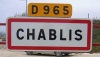 |
However, many towns and villages do not have a specific 50 km/h sign at their entrance. There is a sign like this, giving the name of the place. This sign is the start of the 50 km/h limit. At the far end, there is a similar sign with a red diagonal line which indicates the resumption of the 80 km/h limit. | |
There are many many speed cameras in France. France has zero tolerance for speeding. If you are caught exceeding a speed limit, even by only 1 km/h, a ticket will be sent to your rental company. The rental company will have to provide a sworn statement about who was responsible for the car, and will charge your credit card around €50 for their trouble. Then in due course, you will receive a ticket.
As well as ordinary speed cameras that record your speed as you drive past, France also has average speed cameras. These come in pairs, reading your numberplate as you pass each of them and calculating how long it took you to drive the distance between them. If the time is too short for the speed limit, you get a ticket.
Drinking and driving
Don't do it! France has very strict drink driving laws. You are allowed a maximum of 0.5mg/ml of alcohol in your blood, so two glasses of wine with lunch can put you over the limit. Drink when you get home.
Priority at intersections
The default rule in France (in the absence of any road signs) is that drivers give way to the right. If you are approaching an intersection and another vehicle is approaching from your right, you must give way (yield) to the other vehicle. This rule can be varied by road signs.
 |
This is a standard "Give Way" sign: "Cédez le passage" means "Give way". At the approach to a roundabout the plate reads "Vous n'avez pas la prioritée" (You do not have priority). In either case, approach with caution and be prepared to give way. |
 |
Self-explanatory: stop, and then give way to other traffic. You will not find "four-way stops" in France: they use roundabouts instead. |
 |
This sign indicates that the road you are on has priority over all side roads. The same sign with a black diagonal line indicates that the priority ends. |
Traffic lights
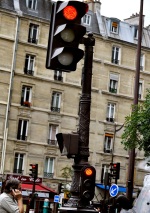 |
Traffic lights in France are to a unique French design, with the main lights high and a small repeater near drivers' eye level. They are usually located only at the approach side of an intersection. They are rarely suspended over a road and never at the far side of an intersection. You must stop sufficiently before the lights so that you can see the repeater. If there are lights at the far side of an intersection, they are a separate set of lights probably protecting a pedestrian crossing. Never drive past a red light. Right turn on red is not permitted, unless there is a green arrow pointing right. When turning left, always give way to oncoming traffic, unless there is a green arrow pointing left. |
Autoroute tolls
Most autoroutes (motorways) in France have tolls, and these can add up to a substantial amount. You can get toll costs from ViaMichelin. There is always a free alternative to a toll autoroute, but it may take much longer to drive.
Usually when you enter a toll road, you take a ticket from a machine. This ticket shows where and when you entered the tollway. When you leave the tollway, the ticket is used to calculate the toll to be paid. There are four ways of paying a toll: Télépéage, credit or debit card, cash to an attendant or cash to a machine. These are indicated at toll gates by these signs (or similar signs):
 |
 or or  |
 |
 |
Télépéage is an electronic tag that has to be linked to a European bank account or card, so a tourist will not have one. You could try using a credit or debit card at a gate for cards, but there is a possibility that a foreign card will not work. Therefore it is better to head for a staffed toll gate, indicated by the third symbol. Hand the ticket to the attendant, and the amount of toll will be shown on a display at driver's head level. Give money to the attendant, who will give change if necessary. Or go a gate with a machine, as described in the next paragraph.
Many toll plazas no longer have staffed gates. In this case, head for any gate that has a green arrow and is not marked as being reserved for Télépéage or cards. Put the ticket into the obvious slot in the machine, and it will display the amount of the toll. Pay with notes and/or coin: the machine will give change if necessary. Gates reserved for tags or cards are shown like this:

There are a few stretches of autoroute that do not use tickets. They have toll plazas across the autoroute that collect a fixed toll. One example is the A8 along the Côte d'Azur, between Ventimiglia and Cannes, where there are two or three fixed tolls. You may find that there is only a basket to collect euro coins.
Refreshments and fuel along autoroutes
|
|
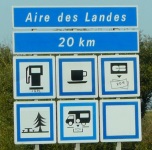
At intervals along the autoroutes, you will find Aires or rest areas. These are signed well in advance, as shown on this sign for the Aire des Landes (on the A62 near Bordeaux). This shows that the aire has fuel, food, an ATM, an outdoor picnic area, and a facility for caravans to dump sewage. The restaurant will probably be quite good, and will have flush toilets. If an aire has only the sign for a picnic area, it may have no toilets or (more likely) there will be pit toilets. |
Obtaining fuel
If you have a credit card issued outside Europe, you will need to plan when to buy fuel. Automatic fuel pumps require a chip-and-PIN card that meets French requirements. The chip-and-PIN cards issued in Australia (and possibly other countries) do not meet this requirement and operate as chip-and-sign in France, so people with such cards will have to buy where a person handles the purchase. You can usually pay a person for fuel at the fuel stations at aires, but maybe from only some of the pumps. For better value, try to buy from supermarkets as they may have a person taking payment during the hours that the supermarket is open.
This all means that you will probably have difficulty in obtaining fuel on Saturday afternoons and Sundays, or over the lunch break on weekdays.
Required equipment
In France, all cars must carry a reflective red triangle and a reflective hi-vis vest. Check your rental car for these items before you drive off. They may be tucked away. The car I rented in 2011 had the red triangle under the luggage compartment floor (next to the spare tyre) and the hi-vis vest rolled up into a small package in the glove box.
If your car breaks down or is involved in an accident, and is not wholly off the road, you must place the reflective triangle on the road 50 to 100 metres behind the vehicle. If you are walking on the road, you should wear the hi-vis vest.
Direction signs
France has good signage telling you which road to take, but it follows French conventions. People from UK complain that the signs do not show road numbers (apart from autoroutes). People from USA complain that they do not show the compass point followed by the road. Instead, the signs show the places that the road will take you to. Quite logical, when you think about it.
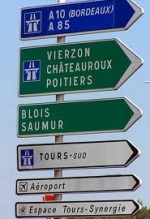 |
Here is a very typical sign, showing where you can get to by turning right. Directions to the autoroute are shown first, with a blue background. Then there are directions to towns you can reach by main road, with a green background. Last come local directions, with a white background. These colours are used consistently to indicate the importance of roads. The blue "chopsticks" patches on the second and fourth signs indicate that there is an option of using an autoroute to get to these places. |
|
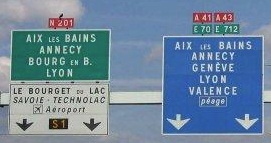 |
This sign is suspended above a main road. It shows you use the left two lanes to travel along the N201 or the right two lanes to travel along the A41 or A43. Notice also that the right-hand sign has a box containing the word "péage" (toll). This indicates you will have to pay a toll if you use the autoroute. |
|
 |
One idiosyncratic aspect of French direction signage is the way you are told to go straight ahead. In this photo, the signs at left point along the road and show you should turn left for the town centre, post office, parking, tourism office, and bus station. However, the signs at right are at an angle of almost 45° to the road. This indicates you should pass to the right of the sign by going straight ahead. Also note that the top sign on the right reads "Toutes directions" (All directions). Follow signs like this to get out of a town centre |
|
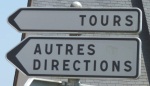 |
The signs can be amusing. This one in Azay-le-Rideau says you should turn left for Tours and also for "Autres directions" (Other directions). It is anyone's guess why they did not use a "Toutes directions" sign. | |
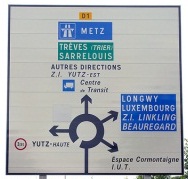 |
Many intersections have an advance sign showing which direction you should plan to take. This is one in advance of a roundabout. |
Roundabouts
Having mentioned roundabouts ... France is very fond of roundabouts (rotaries) for regulating traffic at intersections. They cause considerable anxiety to people from countries where they are seldom used, such as USA, especially when there are two lanes through the roundabout. Rick Steves recommends using the right lane, no matter which exit you want to take, but this is a recipe for disaster. This is what you should do.
 |
If you want to turn right, approach in the right lane and signal right. | |
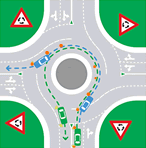 |
If you want to turn left, approach in the left lane and signal left. When you pass the exit before the one you want to take (in the illustration, when you pass the second exit), signal right. If you want to do a u-turn, wait until you pass the third exit before you signal right. Exercise caution, as other drivers may not expect you to continue past the third exit. |
|
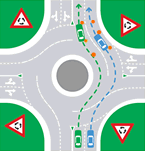 |
If you want to go ahead, approach in either lane with no signal. When you pass the exit before the one you want to take, signal right. This diagram should show why it is a very bad idea to use the right lane if you want to turn left. |
Restricted areas
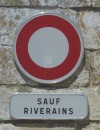 |
Many towns and villages have areas in their centre that are reserved for residents or pedestrians. They are indicated by the "No vehicles" sign, of a red circle with white centre, as shown here. In this case, the words "Sauf riverains" mean "Except residents". If you see one of these signs, do not drive past it unless you are certain that any exemption applies to you. |
A lovely collection of signs
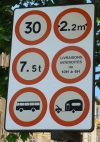 |
Here is a lovely collection of prohibition signs from Arles. Starting at top left, they say: Speed limit 30 km/h, Width limit 2.2 metres, Weight limit 7.5 tonnes, No deliveries between 10 am and 6 am, No buses, and No caravans. |
Common road signs
Further information on roads signs used commonly in Europe is on this page.
Copyright © 2011-21 by Nick Booth. Please contact me if you have any comment.